
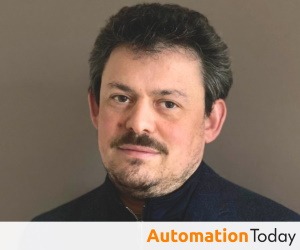
Hundred-year-old businesses are not generally where you expect leading-edge technologies to emerge. But, according to Maxim Ioffe, Global Intelligent Automation Leader at Wesco, an organization with a long institutional memory is the perfect place to incubate innovation and give it room to evolve.
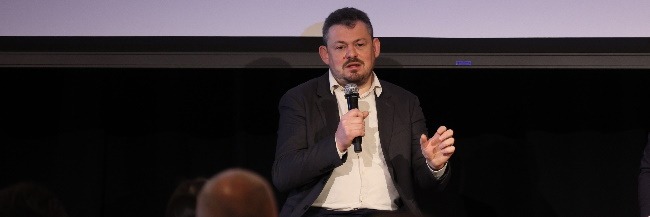
Ioffe sat down with Automation Today recently at UiPath’s annual partner and customer event (renamed FUSION this year) to talk about the balance he sees between heritage and reinvention at the century-old electrical and electronic supply chain distributor and how process automation is changing as agentic AI becomes the dominant technology driving it.
Wesco’s roots run deep. The company that began in 1922 as a spinoff of manufacturing powerhouse Westinghouse serves more than 50,000 suppliers and hundreds of thousands of customers including utilities, data centers, and manufacturing. Ioffe has been with the company for more than 20 years, starting in supply chain optimization—a natural precursor of automation. At an organization as big as Wesco, opportunities to automate processes are abundant, but scale complicates matters.
“It’s easy for us to optimize the process within our four walls,” says Ioffe. “The moment you step outside those walls, you realize your partners aren’t necessarily automated. In 2018, we saw RPA as the automation that would allow us to meet hundreds of thousands of customers, suppliers and partners where they are. I saw it as a way to take the automations that I have internally and really extend them across the ecosystem.”
So, an automation program was born that continues to evolve as providers like UiPath continue to leverage new technologies. As fast as the tech is changing, however, Ioffe believes in some bedrock principles.
Governance Before Code
Wesco’s early forays into automation were deceptively simple: automating purchase-order status checks across multiple supplier portals. What once required employees to log manually into thousands of vendor systems became a task executed by bots in minutes.
In a field often defined by speed and experimentation, however, Wesco’s program began with something rarer: patience.
“We thought about governance before we even bought the licenses,” Ioffe says. “We needed the guide rails first.”
That early discipline spared Wesco the fate of many first-generation RPA programs that scaled too quickly and lost control. When Ioffe assumed leadership of the company’s global center of excellence, he made a promise to IT leadership: no “shadow IT.”
The result was a hybrid model that balanced creativity with compliance. Instead of unleashing unmonitored citizen developers, Wesco built what Ioffe calls “citizen ambassadors.” These employees identify automation opportunities within their business units, but the actual builds remain within the COE, ensuring quality and supportability.
“They bring the idea, we build it for them,” he explains. “Now it’s built to automation standards, it’s supportable, and it doesn’t consume unnecessary licenses.”
That model struck a chord inside the company. It bridged technical and business expertise, translated functional needs into developer-ready pipelines, and scaled participation without losing control.
“With citizen ambassadors, we don’t have the problem of orphaned automations,” says Ioffe. “We can scale without creating chaos.”
The Framework for Scale
Automation at Wesco now operates like any other enterprise-grade system—with processes, checkpoints, and metrics for success. Ioffe credits this structure as the foundation for sustainable growth.
“There’s governance first,” he says. “Then the framework that allows you to turn an idea into an implemented automation. If every project is treated as a proof of concept, you’ll never scale.”
For Ioffe, scale isn’t measured only by bot counts or transaction volumes. It’s about building confidence across functions so that automation becomes a natural reflex, not a special initiative. That requires rules and flexibility.
“If we want to widen the guide rails or take a scenic detour, that’s fine,” he says. “We just go back to IT for approval. But the structure keeps us from treating every idea like a science experiment.”
Support, too, is part of that structure. “If the robot doesn’t show up to work, if your agent is hallucinating, nobody wants to use it,” Ioffe says with a laugh. “You need a support model that treats digital workers like human ones—notify, fix, improve.”
Together, governance, framework, and support form what he calls the “three tenets” of a successful automation program. With his foundation set, Ioffe believes he is ready to take advantage of the next iteration of automation innovation—as long as he keeps a simple philosophy in mind.
Start with Problems, Not Solutions
“Our intake process is built around the business problem,” he explains. “Don’t bring me the tool you want to use. Bring me the issue you’re trying to solve.”
That principle protects Wesco from technology hype cycles. “Every new platform looks exciting,” says Ioffe, “but I have to ask: where do I find the talent? How do I support it? How do I know it won’t shift direction in six months?”
Predictability, he adds, is often more valuable than novelty. “With UiPath, we know the roadmap, and we trust it. I don’t need five RPA platforms or 50 IDP tools.”
But, if there’s one new concept in the automation space that excites Ioffe and that he sees as vital to an AI-based future, it’s the connective tissue between humans, bots, and AI agents: orchestration.
“What attracted us to UiPath in the first place was orchestration,” he says. “You can break down a batch of a hundred purchase orders into queue items, process them in parallel, then reassemble them with full traceability. That’s incredibly powerful.”
The company’s latest experiments with Maestro are expanding that idea further, allowing automation to “pick up the loose ends.”
“For example,” Ioffe explains, “if we send a thousand emails to suppliers and get 900 replies, traditional automation stops there. Maestro lets us handle the missing hundred with no manual trigger required.”
That ability to manage both presence and absence—to act not just on what’s there, but on what’s missing—represents, for Ioffe, the next evolution of orchestration. “It’s that seamless integration between robots, agents, and humans,” he says. “That’s where a lot of real business value lives.”
Human Connection Through Automation
For all the technical sophistication of Wesco’s automation program, Ioffe returns often to one simple truth: automation succeeds only when it brings people together.
“I see it from two angles,” he says. “IT has to handle data security, privacy, and governance. Business just wants outcomes. My job is to build the bridge between those two.”
That bridge begins with defining the rules before deploying technology and extends to joint ownership of results. “If IT is comfortable with the governance, and business is clear on the value, everyone wins,” he says. “It’s the same with agents as it was with RPA in the beginning: clear guide rails, clear expectations.”
Asked what he’d tell his younger self, Ioffe doesn’t hesitate. “Pipeline doesn’t build itself,” he says. “You have to evangelize constantly.”
His Center of Excellence now spends as much time communicating as coding—holding town halls, lunch-and-learns, and one-on-one conversations across departments. “If the culture exists, the pipeline exists,” he explains. “Until you have that, it’s very challenging to move forward.”