


Despite decades of working toward digitization, organizations still spend significant resources collecting, processing and storing documents that could better serve as the foundation for many of their business workflows.
Bruce Orcutt, chief product and marketing officer for ABBYY, has spent nearly three decades working with document capture and automation technology. He believes artificial intelligence has fundamentally altered the value businesses can extract from their documents. Rather than simply preserving records, organizations can use the information they contain to accelerate transactions, inform decisions and support AI-powered automation more comprehensively than ever before.
Orcutt sat down with Automation Today recently to talk about how the evolution of AI-powered automation is influencing ABBYY’s product strategy, including its recently introduced PHOENIX Plus technology and its work with IBM on document preprocessing.
“Historically, the document was for archiving. We wanted a record of what was submitted to us,” he explains. “Now there’s data within that document that really drives decisions and enables processes.”
A Hybrid Approach to Document AI
ABBYY characterizes PHOENIX Plus as an AI layer integrated with its Vantage intelligent document processing platform. The technology combines the company’s traditional strength in intelligent document processing (IDP) and optical character recognition (OCR), with large language models selected and optimized for specific document processing requirements.
The hybrid architecture, Orcutt says, signals an understanding that no individual AI model can consistently deliver across every document category. Instead, the company evaluates different technologies for accuracy, processing speed, reliability and cost.
“We never took the approach that one LLM or one integration is going to be the right answer,” Orcutt says.
PHOENIX Plus uses generative AI to interpret more variable content within ABBYY Vantage, which manages document ingestion, classification, extraction, validation, business rules and human review. Orcutt claims that combining the technologies can increase extraction accuracy from approximately 80 to 90 percent to 97 to 99 percent, depending on the application.
“PHOENIX Plus augments current Vantage processes that are already in production,” he explains. “It makes them better, more efficient and more effective.”
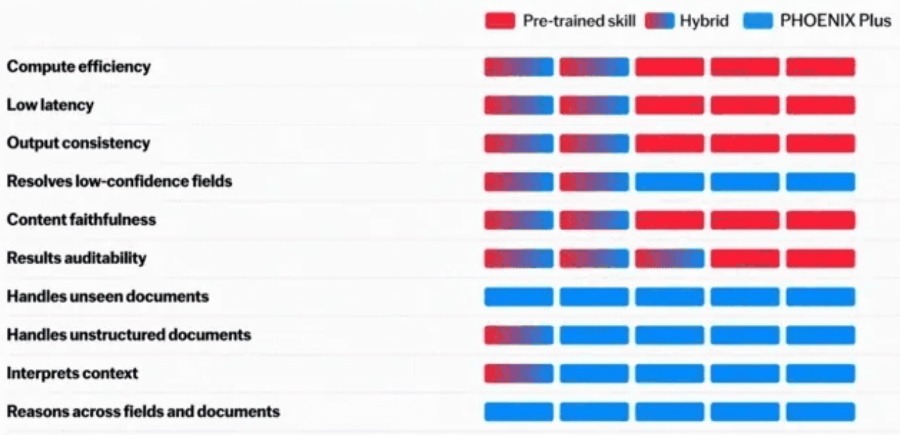
Orcutt also identifies pricing as an important consideration for enterprises adopting generative AI. Rather than charging customers according to fluctuating LLM token consumption, ABBYY incorporates PHOENIX Plus into its annual, page-based licensing model
Turning Documents into Business Results
One of the key metrics businesses apply to IDP is extraction accuracy. But Orcutt believes the more consequential measurement is how effectively document processing supports the business transactions that depend on it.
He cites financial services and the processes required to collect and validate identity documents for loans and account openings as an example. Orcutt explains that automation can evaluate documents as customers submit them, identify missing or incorrect information, and request corrections without waiting for a manual review.
“If we can accelerate that transaction, accelerate that time to revenue, and now we’re funding a loan in three days versus 30 days, what’s that mean to the bottom line?” he asks.
Orcutt also points to a case study from an ABBYY customer in the global consumer goods industry. The company uses ABBYY Document AI for order entry and claims processing as part of a broader automation program encompassing more than 2,000 processes.
Overall, the program returns approximately five million hours annually to the business.
For order processing, the study reports, automation reduced the time required from approximately 2.7 minutes to 18 seconds. The process supports six languages and more than 12,000 customers across 50 markets, returning approximately 17,000 hours annually.
Claims processing provides another example. The company handles approximately five million claims annually, with 96 percent processed straight through. Processing time has fallen from two to three hours per claim to approximately 10 minutes, returning an estimated 62,000 hours annually.
Orcutt says these implementations demonstrate why organizations are increasingly evaluating document automation in terms of transaction throughput rather than individual processing costs.
“That’s what customers are looking for, right? They’re looking to try to take as much of that human cost out of the equation and accelerate those transactions,” he says.
Preparing Documents for the Next Generation of AI
In addition to business automation users, Orcutt highlighted an IDP offering ABBYY has aimed at a different set of users. ABBYY introduced FineParser for developers building AI applications that require information from documents. Unlike Vantage, which addresses enterprise document workflows, FineParser provides preprocessing capabilities that developers can incorporate into their own systems.
Orcutt says with FineParser and an assist from IBM, ABBYY hopes to tap the growing influence of technical practitioners on enterprise purchasing decisions.
“We have the enterprise buyer from the line of business,” he noted. “Now we also have a technical buyer or technical user who’s going to be suggesting and promoting specific capabilities and technologies,” he explains.
At a recent IBM developer event, ABBYY demonstrated how FineParser can prepare documents for downstream processing by Watsonx and other AI technologies.
Orcutt says preprocessing can substantially reduce the number of tokens required by language models while improving their consistency.

“If we run the document as the first step and then hand it over to any LLM or any other downstream process, we see significant improvement in token consumption, plus better consistency and accuracy,” Orcutt says.
He also points to processing speed, claiming ABBYY’s testing has demonstrated response times measured in seconds compared with substantially longer processing times for some general-purpose models.
Looking Forward
Moving forward, Orcutt says ABBYY continues to work with organizations that have extensive repositories of historical documents they have been unable or unwilling to integrate into their AI initiatives.
Orcutt adds that insurers and other large enterprises will use document preprocessing to convert archived information into formats suitable for retrieval and analysis by language models.
He expects ABBYY’s work with IBM to explore these applications, particularly among longstanding IBM customers with substantial stores of proprietary business information.
“Imagine an insurance company with trillions of documents,” he says. “We can pre-process all of it and use Watsonx to convert it to an LLM. Now that insurance company has access to all that hidden data that was dark to them.”