
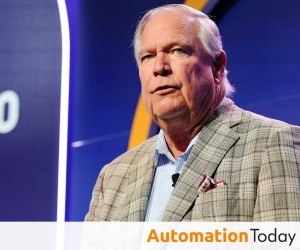
One of the ways SS&C CEO Bill Stone looks at the company he has spent more than four decades building is as an automation proving ground. The Windsor, Conn.-based technology and services giant’s acquisition of RPA pioneer Blue Prism in 2022 provided a solid foundation for SS&C’s AI-driven automation support to enterprises.. The company’s own experience implementing automation has been instrumental in determining how the company approaches its customers.
Stone says one lesson stood out starkly as the company implemented agentic automation internally: don’t forget about the technology that already works. Artificial intelligence and agentic AI are changing the economics and capabilities of enterprise automation. Stone believes businesses should be able to adopt emerging technologies without abandoning their existing investments.
Automation Today sat down with Stone at the recent SS&C Deliver event in Orlando to talk about integrating AI into an existing automation framework, how acquisitions have reshaped his company and where he’s looking for opportunity moving forward.
Buy vs. Build
SS&C’s acquisition strategy has been a defining characteristic of the company’s growth. Stone says the organization has completed approximately 85 acquisitions in 40 years, gaining new capabilities, access to additional markets or opportunities to reduce operating costs along the way.
The Blue Prism transaction emerged the way many of Stone’s M&A bids do: his knowledge of the private equity world and how those firms evaluate potential investments. When Vista Equity Partners pursued the automation vendor, Stone saw an opportunity based on its valuation relative to competitors UiPath and Automation Anywhere.
“What I’ve been pretty good at being able to do is watch what the PE firms do,” he says. “I know how much due diligence they do. And when they go after a company, I always watch.”
The acquisition was important to Stone not only for the potential it represented as a commercial opportunity but for the technology’s potential applications within SS&C. The company has subsequently deployed approximately 3,500 digital workers internally, generating substantial value across its operations.
“We estimate it’s saved us 200 million dollars,” he says.
Crucially, the acquisition provided practical experience informing how SS&C could market automation externally. Meanwhile, the emergence of generative AI a year after the acquisition created new questions around how automation technology should evolve.
Making AI Work with What Customers Already Have
Stone says the growing capabilities of large language models prompted SS&C to reconsider how businesses could incorporate AI into established enterprise systems. The company had already experimented with the technology, but broader adoption raised questions about governance, security and operational control.
Those concerns were particularly relevant to the financial institutions comprising SS&C’s customer base. For those organizations, sensitive information, regulatory requirements and transaction accuracy mean particular scrutiny around implementation of automation technology.
Stone saw firsthand the reluctance of some large financial organizations to permit external AI agents to operate within their technology environments without adequate oversight.
SS&C responded by introducing AI Gateway, intended to control access to AI capabilities and maintain records of their activities. Stone says the development effort took approximately two years.
“We have a whole facility where everything gets logged; everything’s auditable,” he says.
The company subsequently introduced WorkHQ as an orchestration platform connecting conventional enterprise applications, RPA bots, AI agents and human employees. Rather than requiring organizations to replace their infrastructure, the platform is intended to coordinate activities across the operations stack.
Stone says the approach enables customers who depend on established systems to execute critical business processes while taking advantage of AI’s efficiencies. Human intervention points are woven into the process, allowing organizations to assign approval authority over select activities.
“With WorkHQ, you can use your current systems. You can build new agentic agents in it. You can use your RPA bots. You can also have stops where a human has to come in give a ‘go/no-go,” he explains.
For customers with significant investments in automation, Stone believes continuity is an important consideration. He cites global insurance broker Marsh, which has extensive RPA deployments and uses automation in activities including underwriting, information gathering and internal data movement.
Stone says the company’s interest in WorkHQ reflects a desire to introduce additional capabilities without disrupting technology already supporting its operations.
“We don’t make you get rid of your investment in RPA, and customers saw that,” he says. “They want to be able to keep what they have. They want to move forward with an evolution of what they’re currently doing, not a revolution.”
SS&C intends to follow a similar approach internally. Stone describes the company as its own initial customer for new technologies, using its substantial transaction-processing operations to evaluate their practical applications.
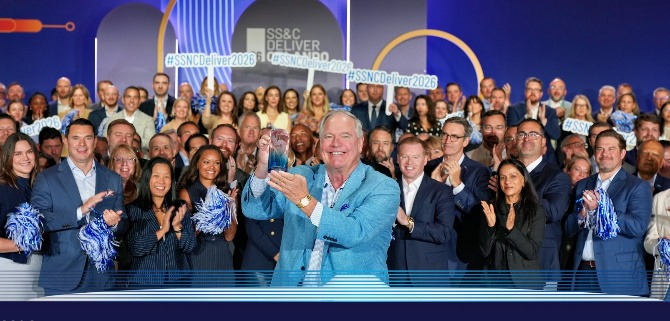
“We’re going to be the biggest consumer of WorkHQ, just like we’re the biggest consumer of SS&C Blue Prism bots,” he says.
Looking Beyond Traditional Financial Technology
In addition to its investments in AI, Stone notes, SS&C continues to pursue acquisitions intended to expand its international operations and financial technology offerings. He says the company’s global strategy requires infrastructure and expertise capable of accommodating differences among regional markets. Its acquisition of South Africa-based Curo Fund Services illustrates how SS&C approaches geographic expansion.
“We view ourselves as a global business, which means we have to be able to process on a global scale,” he says.
The acquisition of Calastone indicates a desire to move beyond conventional transaction-processing systems. The London-based firm operates a network connecting approximately 6,000 investment funds. Stone says SS&C has added more than 500 funds since acquiring the company just last year.
The expansion also illustrates Stone’s preference for acquisitions introducing new services rather than simply adding customers to existing operations.
“You get opportunities when you expand your geographies, when you make sure you didn’t skip an asset class,” he says.
Looking ahead, Stone expects the company’s development strategy to require continued investment and a willingness to accept uncertainty. Established technology providers, he says, cannot assume their existing offerings will remain relevant as customers explore new approaches to automation.
“If you don’t take chances, you can’t advance,” he says. “If you don’t switch from RPA to the next thing, you become irrelevant.”