
After years of prioritizing efficiency, process automation has entered the age of orchestration. The development of AI agents, which can be set to a task and make autonomous decisions to complete it, has led to speculation about and experimentation with a wide range of use cases from coding to commerce.
Organizational processes and workflows have become a primary environment for the application of agentic technology. But the need for a control layer to take the technology from pilot success to enterprise scale has become glaring in the face of complex workflows that need multiple agents to successfully automate them.
SS&C Blue Prism has been a pioneer in the intelligent automation space since it helped coin the phrase “robotic process automation” more than 15 years ago. In 2026, the company is positioning orchestration—how businesses deploy and manage AI agents and traditional automation, the workflows they’re automating, the governance and control around them, and the humans using the technology—as one of the most pressing operational problems automation must solve.
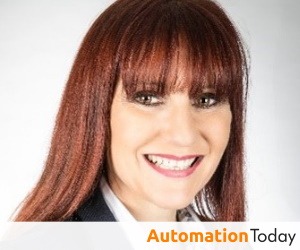
According to vice president of Portfolio Marketing Natalie Keightley, SS&C Blue Prism is arming businesses to surmount that challenge with WorkHQ, a platform designed, she says in a recent interview with Automation Today, “to bring AI, people, digital workers and business systems into a single, governed workflow.”
When it officially launches later this month, she notes, customers will have access to a platform that was developed and iterated upon in lived operational complexity rather than abstract product design.
Built From Operating at Scale
Since acquiring Blue Prism in 2022, the automation unit has used the wider parent company as a proving ground and for design input. As a global software services provider focused on the financial services industry, the Windsor Connecticut-based consultancy has implemented Blue Prism automation technology from the start and used it to both continuously improve the company’s processes and the product itself.
“We use our own business to help us ideate, design, develop, refine, test and, ultimately, apply the results at scale,” Keightley says.
That scale is nontrivial. According to Keightley, thousands of processes have already been automated across the 29,000-plus employee organization, alongside a growing footprint of digital workers and AI agents. The story, however, is less about volume and more about complexity: automation spans financial operations, customer communications, and back-office workflows, all under regulatory constraints.
“Our automation journey to date has seen us automate 3,400 processes,” she says. “We’ve got about 3,600 digital workers deployed across the business and we’ve got 50-plus AI agents deployed. And with WorkHQ, we are going to further expand the scope and value of our automation program.”
But rather than imagining these figures represent the end of an automation journey for a single company, Keightley presents them as markers of product development. Implementation within SS&C exposes the exceptions, compliance constraints, integration gaps and other roadblocks in a real-world environment that shape and improve how our products function in enterprise environments.
“We’re proving everything that we have,” she says. “We’ve been able to generate results not just in terms of cost savings and efficiency, but real improvements in speed, productivity, and the ability to unlock capacity. We’re refining and delivering outcomes to our clients.”
The result is a feedback loop: internal deployment informs product design, which is then validated at scale. This same principle applies with WorkHQ.
Orchestration as the Missing Layer
According to Keightley, WorkHQ unifies traditional automation, AI agents, human workers, and enterprise applications into a coordinated system.
“What WorkHQ is really trying to do is enable organizations to automate more work, to do it at scale and to do it safely,” she says. “It’s a single platform that brings together all the resources that are involved in undertaking that work, focused on collectively delivering the business outcomes that no individual resource can deliver independently.”
Organizations have been leveraging automation for years, but as they attempt to apply existing technology to increasingly complex workflows, it has become evident that agentic AI’s decision-making, and the ability to task multiple agents to create end-to-end workflows, is the best option.
But enterprise systems are not designed to deliver end-to-end outcomes, according to Keightley. They execute discrete functions. Orchestration is required to bridge those functions into coherent processes. A more complex mix requires a new way to oversee and manage automation.
“WorkHQ is natively built to support both deterministic RPA, where correctness and certainty are non-negotiable, and AI agents, where judgment, reasoning, and ambiguity add value,” she says. “Not one or the other. That means you’re using AI for the right things at the right time.”
The orchestration platform cuts through complexity and silos by bringing people, AI, APIs and digital workers into a single workflow, she explains. It delivers agentic automation through a modular, composable architecture with governance embedded in the design, from a company that is accustomed to operating in highly regulated environments.
The platform’s role, she says, is to act as an orchestration layer; a “golden thread” that doesn’t require businesses to “rip and replace” the technology already on hand, but that connects disparate systems and ensures that work is routed to the appropriate resource at each step.
“WorkHQ meets organizations wherever they are on their automation journeys,” Keightley explains. “We don’t force existing customers to migrate. Instead, we help them build on top of their existing automation foundation and expand it with more agentic capabilities to support more complex and a wider range of use cases.”
And governance is embedded as a primary concern within that layer, particularly given the introduction of AI.
“We don’t apply any AI without the right governance,” she says. “WorkHQ includes guardrails, hallucination detection, and controlled input/output handling as essential components, especially in the highly regulated industries we commonly serve.”
Reframing the Role of the Human Worker
While orchestration becomes the focal point of the system, its end goal is workforce transformation.
“People are still the integral part of any organization,” according to Keightley.
She dismisses the idea of replacement versus retention, instead focusing on task reallocation. Highly skilled employees, she argues, are often deployed on low-value, repetitive work due to system limitations rather than business intent.
“When you think about having highly skilled people sifting through reams and reams of data,” she says. “That’s not the best use of their time.”
Automation, in this model, shifts those tasks into the background, enabling workers to engage in higher-order activities such as working directly with customers, pattern recognition, and service expansion. This shift introduces new skill requirements, reinforcing the need for workforce adaptation rather than static job definitions.
“There’s no doubt that skills are changing,” she notes. “New jobs have been introduced, existing jobs are changing, and people need to be up leveled,” she says.
As a company, SS&C believes AI and human workers will be collaborating more than ever moving forward. More non-technical people will use AI tools via user-friendly applications and prebuilt models and larger enterprises increasingly will mandate AI training for employees. Those who can guide AI systems to produce accurate, relevant, ethical results will be in high demand.
As platforms like WorkHQ move from early deployment to broader availability, the emphasis appears to be shifting from automating individual tasks to managing entire systems of work. The next phase may depend less on how much work can be automated, and more on how effectively organizations can coordinate the growing mix of humans, bots, and AI agents operating within their processes.