
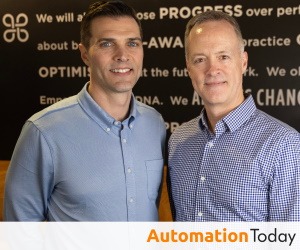
Business leaders who feel overwhelmed by the inexorable pressure to implement, operationalize and realize a return on agentic AI should know they’re not alone, say Don Sweeney and Marshall Sied, co-founders of Ashling Partners.
The technology many are struggling with now isn’t an end. It’s a powerful tool that will help organizations automate their processes and find more value than ever, the partners acknowledge, but it’s early in a timeline that has played out before.
Sweeney and Sied, recently sat down with Automation Today to talk about turning the urgency many leaders feel around AI into something more durable: working automation programs. It’s a market, they say, caught between experimentation and execution, where they want results from AI but often approach it as an add-on rather than spending time redesigning processes using the technology as an enabler.
It will be truly powerful, Sied predicts, when no one is thinking about it anymore. In the meantime, Sweeney, Sied and the rest of the team at the Chicago-based consultancy will keep its focus where it should be.
“It’s not going to be ‘AI-led automation,’” he says. “It’s just going to be ‘automation.’ It’s just going to be how we operate. And the biggest piece isn’t the technology. It’s reimagining the processes leveraging the technology.”
AI Isn’t the Strategy—Process Reimagination Is
When it was founded in 2017, Ashling was named for the Gaelic word meaning “vision.” Their vision was to create truly efficient end-to-end processes using the most advanced technology available. At the time, that included RPA, OCR, machine learning models and more. After the public launch of ChatGPT, however, the hype created an environment where the technology wasn’t necessarily serving business goals.

For Sweeney and Sied, one of the most persistent misconceptions is that AI represents a fundamentally new category of work rather than an extension of automation discipline. He points to earlier waves of technology adoption to make the case that the terminology will fade, but the operational expectations will not.
“We always say AI and agentic AI is just another form of automation. It’s decisioning automation, but you still need the same guardrails,” Sied says.
He suggests that many organizations are taking existing workflows and layering AI capabilities on top rather than questioning whether those workflows should exist in their current form at all.
“We thought we could truly redefine it and provide 30 to 40 percent efficiency gains as opposed to just twisting the dial slightly and wringing out small improvements,” Sied says.
That distinction, he argues, is where most AI initiatives either plateau or scale. Embedding AI into legacy processes may deliver incremental gains, but it rarely produces the step-change improvements leaders expect.
Sweeney reinforces that point by emphasizing the importance of anchoring any initiative in business outcomes rather than technology capabilities.
“You can’t implement a tool simply because it’s an amazing technology,” he states. “It must solve a problem.”
Ashling, he says, adheres to a discipline where every proposed change is measured against enterprise objectives, not technical feasibility.
“We run every change we propose through a value management tracker to answer the question, ‘does it enhance the value or not?’” Sweeney says.
That focus, according to both, forces organizations to confront a harder question. Not “what AI can do?” but “what problems are worth solving?”
Adoption Will Be Slower (and Messier) Than Expected
Despite the startling pace of AI announcements that breathlessly report the advancing capabilities of various models, Sied pushes back on the idea that enterprise adoption will follow the same rapid trajectory.
“I think it’s going to take a little longer to have true enterprise-wide adoption,” he says.

He attributes that to a mix of technical, organizational, and governance constraints, particularly in regulated industries. In practice, most organizations are landing in a hybrid state—combining deterministic automation with probabilistic AI systems rather than replacing one with the other. He notes virtually no enterprises are ready for fully probabilistic technology.”
Sweeney adds that the market dynamics themselves are contributing to confusion, with constant exposure to AI narratives creating pressure to act—even when readiness is low.
“There’s certainly a lot of FOMO,” he admits. “You can’t even pick up a sports page without hearing about AI.”
That pressure often leads to pilot programs that fail to translate into production value, reinforcing skepticism at the executive level.
“There’s a lot of people who are still struggling with how to best roll this out at an enterprise grade,” Sweeney says. “I talk to executives every day who tell me, ‘I’ve run a pilot and it didn’t really work out.’”
At the same time, he points out that mixed results are not universal, with some organizations reporting measurable gains while others pull back due to risk concerns. The implication is not that AI fails to deliver, but that outcomes are highly dependent on how and where it is deployed.
The Operating Model Gap Is Where Most Programs Stall
If there is a single point of failure across AI initiatives, Sweeney and Sied suggest it lies in operating model design rather than model performance. Sied describes a recurring pattern: organizations investing in use cases without aligning governance, architecture, and delivery structures.
“We see this hammer-looking-for-a-nail syndrome all the time,” he says. “We saw it with RPA. Now we’re seeing it with agentic AI.”
To counter that, he outlines a structured approach: governance, security, talent, and pipeline management first, with technology selection as the layer that executes against all of it. The platforms winning in that layer, Sied and Sweeney note, rarely stand alone. Organizations generating the most value are combining tools like UiPath’s Maestro to orchestrate across agents, robots, and humans, with a hyperscaler infrastructure (Azure, AWS, Google Cloud) rather than forcing a single tool to carry an end-to-end flow.
“Obviously, strategic direction and governance are most important,” Sied says. “Governance, unfortunately, is a double-edged sword,” he shrugs. “It allows us to get to production and slows us down.”
Security and explainability represent another friction point, particularly as organizations move from deterministic automation to probabilistic systems. Talent also emerges as a constraint, with traditional separations between business and technical roles becoming less viable.
“Your people are going to have to be a mix between technical and functional,” he predicts. “You can’t segregate that anymore.”
Meanwhile, the process of identifying and prioritizing use cases can also introduce barriers. That responsibility, Sied notes, often becomes fragmented across multiple teams, slowing momentum and diluting impact, particularly when organizations lack a unified decision framework.
Finally, both emphasize that measuring success is evolving beyond cost reduction.
“It can’t just be cost out,” Sied says, pointing to broader metrics such as customer experience and adoption.
From Experimentation to Discipline
What emerges from the Ashling team is not a rejection of AI’s potential, but a reframing of how organizations should approach it. The shift is less about adopting new tools and more about rebuilding the governance, talent, and process design systems around them.
The next phase, according to Sweeney and Sied, is unlikely to be defined by breakthrough models alone. Instead, it will hinge on whether organizations can translate experimentation into repeatable operating discipline.
That transition is already underway, even if unevenly distributed. As enterprises move beyond pilots, the pressure will shift from proving that AI works to proving that it works consistently under constraints, at scale, and within the realities of existing systems.