
There is a growing sentiment among end users of business process automation technology that releasing a new platform labelled “agentic” isn’t the quantum leap forward suggested by the work of the frontier AI labs. Moreover, some organizations say they would prefer a back-to-basics approach for the kind of workflows they want to automate.
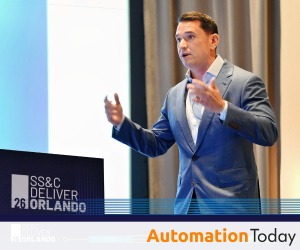
Rob Stone, general manager of Intelligent Automation and Analytics at SS&C, didn’t grow up in automation. After SS&C acquired RPA pioneer Blue Prism in 2022, Stone was tapped to lead the business and integrate the technology into SS&C’s own operations before commercializing it.
As he researched the space and saw the tech’s actual capabilities up close, he saw how quickly some vendors were relabeling existing capabilities as agentic. Stone believed some were hyping existing capabilities as a fundamental difference, while failing to acknowledge what customers actually need their technology to accomplish.
Stone and CTO Anthony Caiafa recently sat down with Automation Today at SS&C’s annual customer event, SS&C Deliver, to talk about the evolution of WorkHQ, the Windsor, Conn.-based company’s enterprise agentic automation and orchestration platform. They emphasized combining automation methods, strong governance when the workflow calls for AI and, most importantly, focusing on the real operational requirements of their customers.
“It isn’t AI for everything,” says Stone. “We want to be outcome driven.”
An outsider’s approach
Prior to taking over automation, Stone spent 15 years at SS&C working in investment accounting and outsourcing. That experience, he explains, taught him to focus on operational problems rather than technology categories.
When he began examining agentic automation, Stone expected to discover that SS&C was behind its competitors. Instead, he says, he encountered some descriptions that appeared to rebrand conventional robotic process automation as AI.
What attracted his attention internally was a different development: employees were combining large language models (LLMs) with digital workers already supporting SS&C’s businesses. Stone says the phenomenon indicated the pain points to solve and what services customers in similar situations might need.
“The benefit I had was this huge estate of digital workers that got deployed internally at SS&C,” he says.
According to Stone, Blue Prism’s experience with RPA showed the importance of orchestration: the right approach was to develop a platform directing traditional bots, AI, humans and agents where each was needed within a workflow. He was able to tap the company’s extensive experience serving verticals including insurance, financial services and health care to identify use cases, then package the technology with managed services. Customer interest encouraged SS&C to continue developing its platform this way rather than lean on a change in branding.
“It gave me conviction that we did really have some time to be building towards what we wanted to be, not rushing to what we thought we had to pretend we were,” he says.
Stone describes the resulting philosophy as choosing among available capabilities according to the task. He says SS&C’s operational specialists contribute knowledge of the processes customers run, while its automation technology supplies ways to execute them.
One of the first companies to benefit from WorkHQ was Marsh, the professional services giant specializing in risk and strategy. At Deliver, Stone presented with Marsh’s Global Transformation and Change Leader Amanda Roberts on their experience with WorkHQ.
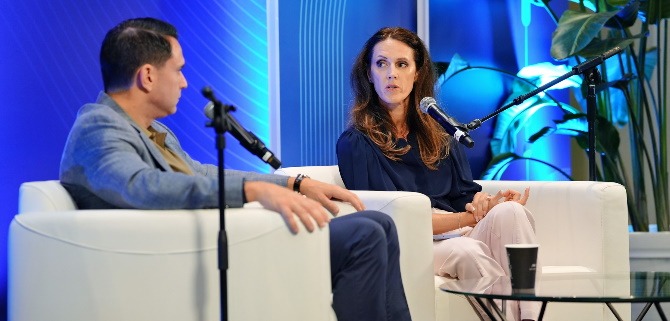
Marsh leans on WorkHQ as an orchestration layer to benefit the entire organization, not just individual workers. The platform, Roberts said in the session, “helps us ensure agents are used in proper and consistent ways between employees.”
AI-driven automation, she notes, cannot effectively operate without strong governance, which Stone and Caiafa echo.
Give governance a working role
According to Caiafa, governance starts with employees who understand the underlying systems and business requirements. In his view, domain knowledge informs where agents can contribute and what connections they need to perform useful work.
At that point it is up to the organization to respond with acceptable alternatives or employees will find their own workarounds. Unauthorized use is problematic, he says, but difficult to eliminate because workers have strong incentives to find faster ways to complete assignments.
“I think it’s probably next to impossible to keep unsanctioned or shadow AI completely out of your organization,” he says.
SS&C’s response was AI Gateway, which combines restrictions with access to approved tools.
The platform evolved from the requirement to support multiple models while managing the exchanges between those models and corporate systems. AI Gateway handles request routing, data redaction, hallucination detection, prompt monitoring and token limits.
“That gives us the ability to tightly control what models are used and where the data goes,” Caiafa says.
Additional controls also can address a burgeoning problem with AI: cost. He says AI Gateway can report token costs in real time, enabling customers to test with low-cost models and escalate requests to more powerful models when the results warrant it.
Stone extends governance to the permissions assigned to individual agents. He says WorkHQ limits an agent’s access according to its function, rather than granting it broad access to organizational information. That makes executives more comfortable authorizing deployment, he notes.
“Governance isn’t a brake; it’s the steering,” Stone says. “The guardrails allow you to know and execute on where you want to go and how fast you want to get there.”
Caiafa expands on the relationship between governance and speed. He says development and data handling will accelerate with AI, but customers still have their own testing responsibilities before putting systems into production. Faster iteration, he believes, does not remove those requirements, it makes them more important.
Plan for changing models and requirements
With the pace of AI development in mind, Stone notes that flexibility in an agentic platform becomes paramount. What happens when a model supporting a critical workflow becomes unavailable, is discontinued or no longer meets a customer’s acceptable-use requirements, he asks.
“You better have an ability to be very portable in the technology you use, all the way down to the individual model that powers any agent in your workflows,” he says.
To that end, Stone says, WorkHQ enables agents and workflows to invoke one another, allows third-party agents to participate and facilitates orchestration across systems. He presents interchangeability as a requirement SS&C demands.
“We wouldn’t want to be locked in by our vendors,” Stone says. “We don’t think our clients would want to be locked in either.”
While organizations will continue to explore agentic AI to automate workflows, Stone knows the customers SS&C serves have complex needs. Highly regulated industries like financial services, insurance and healthcare organizations will always have requirements on where information can travel, even when meeting those conditions increases implementation effort.
But SS&C has a history of using its own operations to ideate, design, develop, refine, test and, ultimately, apply the results at scale. The company has incorporated those lessons into WorkHQ. Stone knows the regulated industries SS&C serves hold AI to a higher bar, and he believes WorkHQ is built to meet that standard.