
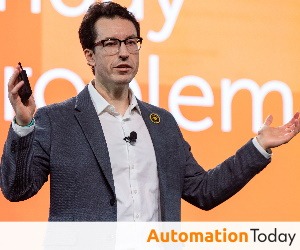
“Agentic AI has infiltrated conversations at every level of every organization. Businesses that don’t consider the educational and operational hurdles they will face in any implementation before imagining the capabilities of the technology may be doomed before they even start,” says Micah Smith.
Smith, vice president of developer relations, community and learning at Automation Anywhere, sat down at the company’s recent Imagine event in Dallas with Automation Today to talk about the importance of teaching technical teams and business users how to work together, how AI is making automation roles converge and how training is evolving.
Smith argues that enterprise automation programs need the right operating model for their stage of maturity. In the early stages, a center of excellence can help establish governance, standards, best practices and momentum. But as automation demand grows across the organization, companies often need to move toward a more federated model, where individual business functions have greater ownership over automation priorities, delivery and adoption.
That shift requires more than technical capability. Automation leaders need to understand their stakeholders, know what each part of the business is trying to accomplish and design a model that supports those needs without losing enterprise-wide governance.
That operational perspective now shapes much of Smith’s work across developer relations, training and customer community initiatives. As organizations move from early AI experimentation to scaled agentic AI deployments, he says education and community become essential to helping technical teams and business users build a shared understanding of how automation should be designed, governed and adopted.
Moving Beyond Product Features
Smith argues that enterprises evaluating agentic orchestration platforms often underestimate the importance of training ecosystems, peer collaboration and reusable implementation guidance.
“Evaluating the technology is just one piece of the puzzle,” Smith says. “The other piece of it is what you get from a support perspective, what you get from a training perspective. What’s available in terms of community, what’s available in terms of pre-built assets that I can learn from and learn how to apply things for myself?”
According to Smith, enterprises frequently struggle less with building an individual automation and more with scaling programs across large organizations while maintaining governance and executive alignment.
“It’s one thing to build a technical solution. I can build a bot, I can build an agent,” Smith says. “It’s another thing to run a program at scale across my organization that includes the governance, the reporting, the evangelism it takes to successfully launch and grow a program at scale.”
That thinking led Automation Anywhere to expand its Pathfinder initiative beyond developer-focused technical education into broader community programming for automation leaders and business stakeholders.
Smith says the company now operates multiple engagement formats, including developer meetups, user groups and “Product Club” sessions that focus on practical implementation guidance tied to recent product releases. Many of those sessions include customers sharing operational experiences and implementation strategies with peers.
Why Automation Roles Are Starting to Converge
Smith points out a growing convergence between technical and business responsibilities inside AI automation programs and has adapted Automation Anywhere’s training to account for it.
At the company’s Imagine event, the company introduced a new AI automation engineer certification program Smith says attempts to combine traditionally separate skill sets.
“On one side, if you’re really technical, you need to start being more business-minded,” Smith says. “You need to start thinking about the outcomes that you’re driving, not just thinking about how this LLM works, or this API call works.”
Smith argues that the reverse is true for business-side personnel increasingly expected to participate in AI-driven process design.
“On the other side,” he says, “if you’re a business user, you need to start thinking not only about business problems, but how can technology help solve them.”
The certification program attempts to address both sides simultaneously through self-paced online training focused on identifying automation opportunities, designing solutions, building agents and evaluating outputs.
“With the AI automation engineer certification, we’re attempting to thread that needle,” Smith says.
To receive their certification, participants build a multi-agent solution to identify and score automation opportunities and schedule follow-up collaboration sessions automatically.
Turning Automation Training into Applied Problem Solving
Smith also describes a broader shift away from traditional certification and testing models toward applied exercises that mirror real operational problems.
“Traditional methods of testing aren’t going to be relevant anymore,” he says. “If I give you a multi-choice test, an agent can just figure it out.”
As a result, the certification process now requires participants to build and submit functioning automation projects demonstrating practical use of AI agents, automation cloud services and orchestration capabilities.
“We need you to prove that you know how to apply what you’ve learned,” Smith says.
Beyond formal certification, Smith says gamified learning initiatives are increasingly becoming part of enterprise automation education strategies. Automation Anywhere’s Agentic Quest platform includes timed exercises and simulated use cases intended to expose users to different implementation approaches.
One example recreates cyber-loss prevention workflows modeled after financial services fraud-monitoring scenarios.
“The people who work in cyber are constantly scanning the dark web to find stolen credit card numbers,” Smith says.
“We’ve created a fake dark web application and a bunch of stolen credit card numbers that are mocked-up,” he continues. “You’re supposed to capture all of that, and automation will scan through it.”
Smith says those exercises attempt to move learners away from rigid tutorials toward more exploratory problem-solving environments where users experiment with different approaches and technologies.
Looking ahead, Smith suggests the growing overlap between business strategy, AI governance and technical implementation will continue reshaping how enterprises structure automation teams and training programs.