
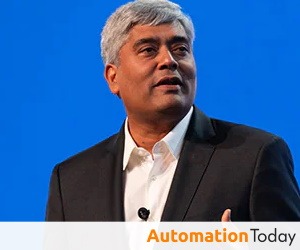
Since November 2022, business conversations have centered on AI and little else. Despite all the attention and promise, however, Mihir Shukla thinks the enterprises driving those conversations are still asking the wrong question.
For the co-founder, chairman and CEO of Automation Anywhere, the issue is not what individual use cases will produce the best results with AI. It is whether organizations are willing to rethink how work itself gets done. Incremental improvements, he argues, will not satisfy boards or CEOs facing mounting pressure to generate measurable returns from AI investments.
“The biggest question is ‘what should my enterprise AI strategy be?’” he says. “Companies are trying many different things because it’s still an emerging area and there is a plethora of ideas, but often there is no cohesive strategy.”
Shukla, in a wide-ranging conversation with Automation Today at Automation Anywhere’s recent Imagine 2026 event in Dallas, said many current approaches fall short of enterprise transformation. Copilots, he says, improve individual productivity but do not fundamentally change how organizations operate. Traditional enterprise software providers, meanwhile, remain constrained by business models tied to existing systems and licensing structures.
“AI is a completely different way to imagine possibilities,” he says.
That broader rethinking sits at the center of what Automation Anywhere calls the “Autonomous Enterprise,” a concept the company says can be achieved with its Agentic Process Automation platform and agentic solutions. The strategy, according to Shukla, is not about layering AI onto existing workflows. It is about redesigning enterprise operations around autonomous and AI-assisted execution.
Rethinking Enterprise Operations
Shukla defines the autonomous enterprise through three characteristics, beginning with a dramatic expansion of automation itself.
“The first is that 80 percent of work should be either fully autonomous or AI assisted,” he says.
“You can’t automate five or 10 percent. You have to push it all the way to 80 percent, which means you’re reimagining how AI can run your business, not just piloting another IT project.”
A phenomenon Shukla calls the “SaaS tax” is preventing organizations from fully leveraging the second characteristic that marks an autonomous enterprise: agentic automation that orchestrates across applications and reduces the need for more software licenses.
Enterprises, he says, have spent decades building IT environments in which increasing operational scale automatically translates into rising software expenditures.
“As we grow, we are used to paying every SaaS vendor a little more,” he says. “It’s like a toll booth on a road.”
Shukla argues that AI-driven orchestration could alter that economic model by reducing reliance on labor-intensive workflows and fragmented software layers. He claims enterprises could redirect spending away from maintenance and toward transformation initiatives.
“What if only 40 percent of your costs are keeping the lights on?” he asks. “Now your IT is the engine of innovation.”
The same logic applies to Automation Anywhere’s objection to software vendors embedding AI agents directly into their own platforms. Shukla acknowledges the rapid expansion of agents across CRM, ITSM and productivity platforms, but he frames many of those systems as inherently limited by their dependence on closed application ecosystems.
“If you approach it that way—use what you already have and map new technologies onto it—you can only gain incremental improvements,” he says.
Instead, he argues enterprises should focus on business outcomes rather than preserving existing architectures.
“Of all times we have experienced, this is the one where exponential change is possible and exponential results are expected,” Shukla says.
The third characteristic of the Autonomous Enterprise is about talent. According to Shukla, the Autonomous Enterprise doesn’t mean fewer people. Instead, every employee can be three times more productive.
The Emerging AI Orchestration Layer
Automation Anywhere is committed to orchestration and the idea that enterprise AI requires a centralized layer capable of coordinating agents, applications and workflows across disconnected systems.
Shukla believes an orchestration layer will become foundational within the evolving enterprise AI stack.
“I think we are the center of the new AI stack,” he says. “If you think about it, the old stack was databases and application software with some user interfaces. I think in the new stack you have compute and LLMs that give you intelligence. Then there are orchestration agents and a layer that runs your business.”
According to Shukla, Automation Anywhere’s historical focus on automation execution gives it an advantage over software vendors now moving into AI agents from adjacent categories such as CRM, productivity or IT service management.
“For us, that’s not coming from anywhere. This is all we did,” he says. “Today, we run 450 million agents and automations for some of the largest companies on the planet and thousands of midsize companies.”
The company also expanded their packaged “agentic solutions” that target functional business domains including finance, IT and support operations. Shukla describes these offerings as substantially different from traditional enterprise software interfaces.
“The new solutions are orchestrating autonomy,” he says.
He points to deployments involving predefined collections of AI agents capable of handling operational work with limited human intervention.
“In certain areas you get 67 percent of the autonomy in first week,” Shukla says. “If it sounds unbelievable, give it a try.”
Shukla repeatedly returns to speed of implementation as a defining factor separating current AI deployments from earlier enterprise transformation projects. He claims organizations can move from pilot programs into production environments within weeks rather than quarters.
That acceleration has also influenced Automation Anywhere’s “pilot to production” initiative, which Shukla describes as an effort to reduce stalled experimentation inside enterprises.
“Sometimes it looks like it’s a way to avoid making a decision,” he says of prolonged pilots. “We told our customers that we will make this happen in production.”
Managing the Human and Organizational Shift
While much of the industry conversation around AI centers on productivity gains, Shukla acknowledges broader concerns surrounding workforce disruption and public anxiety over automation.
Those discussions, he notes, increasingly involve government leaders, HR executives, unions and enterprise transformation teams simultaneously.
“We measure that we had about three billion interactions on this topic with customers in 90 countries,” he says.
Those conversations became part of Shukla’s recently released book, Five-Year Century, a National Bestseller that is co-authored with Nancy Hauge, Automation Anywhere’s Chief People Experience Officer. The book’s title reflects their argument that the next five years will compress decades of technological and organizational change into a far shorter timeframe.

“We think that a century worth of change will happen in the next five years,” Shukla says.
At the same time, Shukla argues organizations cannot rely exclusively on executive leadership to define how AI reshapes work. He believes employees themselves must actively participate in redesigning their own roles.
“If you don’t reimagine your role in the age of AI, somebody else will,” he says.
Rather than presenting automation purely as a replacement mechanism, Shukla frames AI transformation as a broad operational redesign that will require participation from across the enterprise. Whether organizations adopt that framing — or continue pursuing narrower AI implementations tied to existing software ecosystems — may shape how quickly autonomous operating models move beyond conference stages and pilot projects.
“There are unbelievable outcomes possible,” Shukla says. “This is just the beginning.”